This week in our continuing 15 projects for 15 years, we bring you our director James’ favourite project. Read on for an interesting and enlightening choice…..
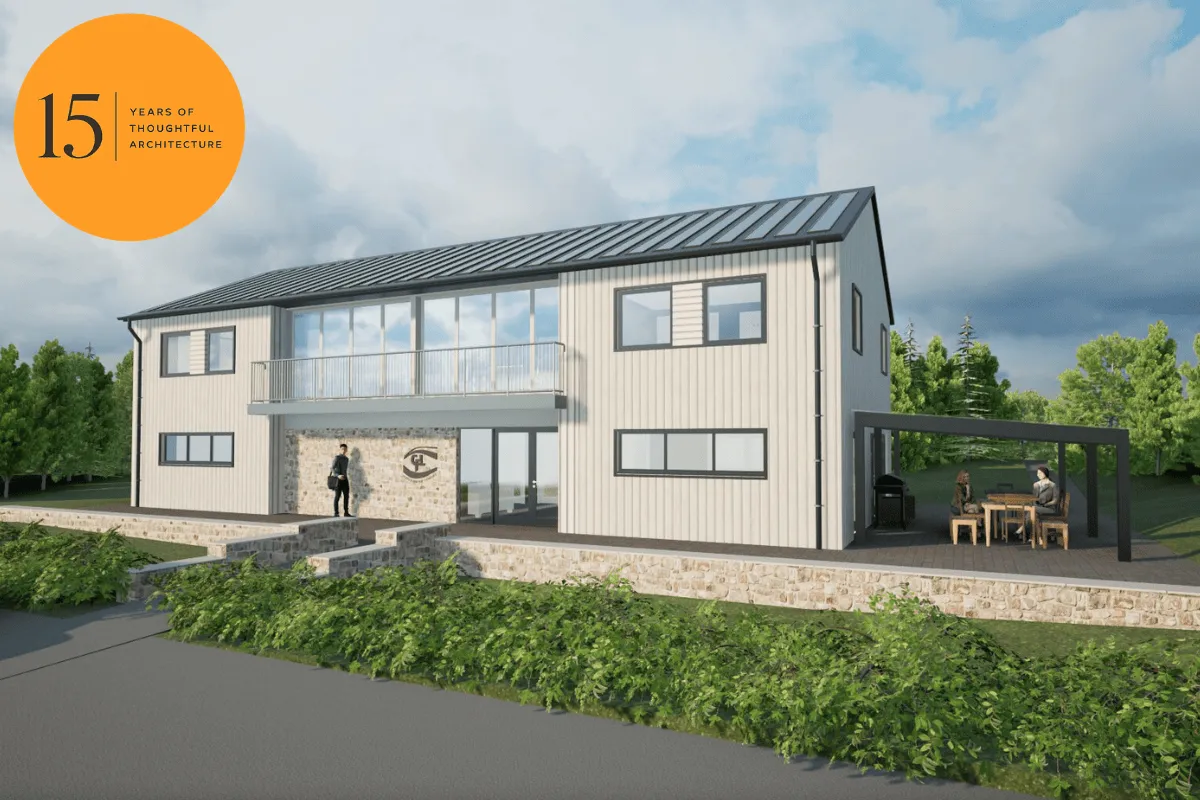
“Looking back over the last 15 years at Thinking Buildings, we’ve had the privilege of working on hundreds of projects across the UK. Choosing just one favourite isn’t easy, but one project has always stood out to me – designing a new headquarters for Consolidated Fisheries Limited (CFL) in the Falkland Islands.
At first glance, it was a relatively familiar brief. A growing business needed a modern office that reflected its ambitions and provided space for future expansion. Their existing accommodation, like many commercial buildings on the Falklands, had evolved from adapted houses and no longer met the needs of the organisation. They had identified a potential site and had a clear vision for what they wanted to achieve.
What made the project so memorable wasn’t the type of building, it was where it was and how we had to deliver it.
Working with a client over 8,000 miles away brought challenges that we hadn’t experienced before. Long before remote working became commonplace, we were relying heavily on video meetings to develop relationships, discuss design ideas and move the project forward. Although I was fortunate to meet the client in person on a couple of occasions when they visited the UK, almost the entire project was delivered remotely.
The project itself progressed over several years, with changing briefs, planning challenges, budget considerations and, ultimately, the disruption caused by the COVID pandemic. Like many major developments, it experienced periods of momentum followed by unavoidable pauses, but every stage taught us something new.
Perhaps the biggest learning experience was understanding how architecture needs to respond to its location. While the Falkland Islands share many planning and legal principles with the UK, they have developed their own distinctive way of working. Designing there meant considering factors that we rarely encounter on projects closer to home. Material availability, shipping times, procurement, construction methods and overall project costs all had a much greater influence on the design process. Every specification had to be carefully considered, balancing performance, practicality and availability rather than simply selecting the ideal product.
For me, this project perfectly demonstrates what architecture is really about. It’s not simply designing buildings; it’s understanding people, place, logistics, culture and context, then bringing those together into a practical solution. It challenged us to adapt, communicate differently and continually rethink our assumptions.
Fifteen years on, that remains one of the things I enjoy most about architecture. Every project brings something new to learn, and sometimes the most rewarding projects are the ones that take you furthest outside your comfort zone, even if they’re thousands of miles away.”