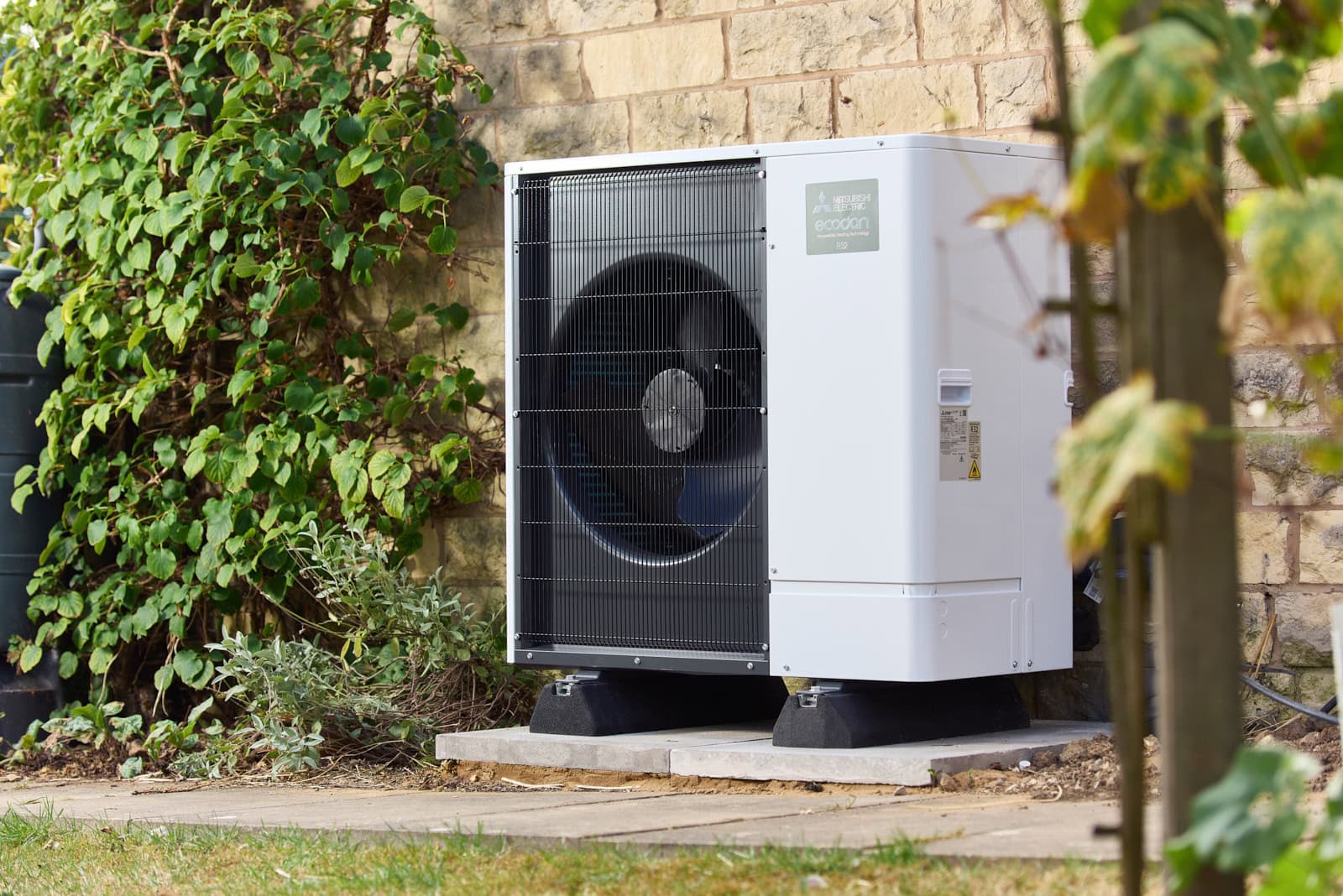
The Passivhaus Trust have recently released best practice guidance on ‘The right time for heat pumps: decarbonising home heating in a staged retrofit’. Their document discusses the how and when to make the switch from gas boilers to heat pumps in order to avoid unintended consequences, such as increased running costs or a reduction in thermal comfort.
Following on from our previous article on ‘Heat Pumps: Is this the future of home heating in the UK?’ we wanted to explore why decarbonising the national grid is important, when it is best to install a heat pump, and how to get the best efficiency from it.
Why is decarbonising the National Grid important?
Heating buildings accounts for 23% of the UKs carbon emissions. One way to reduce carbon emissions is by making everything electric and relying on decarbonisation of the National Grid instead. Switching to heat pumps could make this a viable option.
However, to achieve the 2035 decarbonisation target, the amount of electricity generated and connected to the network would have to treble to meet the current demand. Therefore, to achieve a net zero grid, both an increased uptake in heat pumps and energy efficiency improvements will be required to existing houses. Both these things will reduce the consumer heat demand and also the total peak load on the grid.
As well as incorporating a heat pump, the best way to improve energy efficiency in existing buildings is to improve the building fabric. This will help reduce:
- operational cost of the heat pump.
- the size of the heat emitter (radiators) and heat pump reducing capital cost.
- Peak demand on the grid.
When is it best to install a heat pump?
The cost to improve building fabric and install a heat pump can be expensive to do all at once. A staged approach can make this more manageable such as ‘Step-by-step EnerPHit’ or ‘AECB CarbonLite Retrofit’. But at what stage is it best to install a heat pump – before, during or after improvements to the building fabric? The Passivhaus Trust have compared the running costs of a heat pump at different fabric performances using their PHPP software to answer this question. Refer to the Passivhaus Trust’s ‘The right time for heat pumps: decarbonising home heating in a staged retrofit’ for the full results.
The running costs of a heat pump will be higher than a gas boiler if no fabric improvements are made. By installing cavity wall and loft insulation, and replacing double glazing, this can help reduce running costs to the same level as a gas boiler. A key aspect when comparing the running costs of a heat pump is that electricity is currently 4 times the cost of gas.
The Passivhaus Trust have concluded the following staged retrofit approach when thinking about installing a heat pump:
- Installation of insulation which removes the need to upgrade radiators and a smaller heat pump is required. These works are required for heat pump subsidies.
- Improve the airtightness and ventilation to ensure good thermal comfort and air quality.
- Install a heat pump, and may also need replacement radiators and hot water cylinder.
- Replace windows, floors, and install additional wall insulation.
How to get the best efficiency from a heat pump?
Heat pumps use energy to raise the temperature of a refrigerant from the outdoor air temperature to that required by the heating system. How long the heating is on for can be really important. For example, you could heat a house to 20 degrees with the heating on for a third of the time or you could keep the house at 20 degrees by heating continuously and the heat pump would actually use less electricity (over an annual period). This is because heat pumps are most efficient when supplying heat at low temperatures. Running a heat pump continuously but with a low radiator temperature is more efficient, but the downside is, this increases the overall heating demand. This means that by running it continuously you lose more heat but generate it more efficiently.
In light refurbishment scenarios the air source heat pump (ASHP) comes out more expensive when run intermittently. This is because higher flow temperatures are required to heat over a shorter time ie. The coefficient of performance (COP) of the heat pump reduces. An effective method with conventional heating to reduce running costs is by limiting the time it’s on. This doesn’t work with ASHP and will in fact increase running costs if heating at the same room temperature. An important issue is also the variation of the COP with external temperature . A gas boiler will give you the same heat output for a given cost but a heat pump in colder weather will give you significantly less heat output than in warm weather.
So are heat pumps the future?
Changing from gas boilers to heat pumps will reduce carbon emissions, and combined with fabric improvements, will reduce energy demand and running costs. Heat pumps do work in uninsulated buildings but it is harder to get the running costs at a level equivalent to or better than gas. There would need to be a shift in the way we heat our buildings, as occupants intermittently heating their homes mean that a heat pump will work less efficiently leading to higher running costs and lower temperatures. The recommendation is to make fabric improvements, such as mechanical ventilation with heat recovery (MVHR) cavity/ loft insulation, and airtightness measures prior to having a heat pump installed. Taking all this into account, heat pumps will work effectively in conjunction with building fabric improvements and continuous heating.
If you would like any further information, we have a dedicated low energy section on our website, as well as Rachel, our an inhouse certified Passivhaus designer, who wrote this article. We would be happy to discuss more with you about your next project, do get in touch if we can help you.